







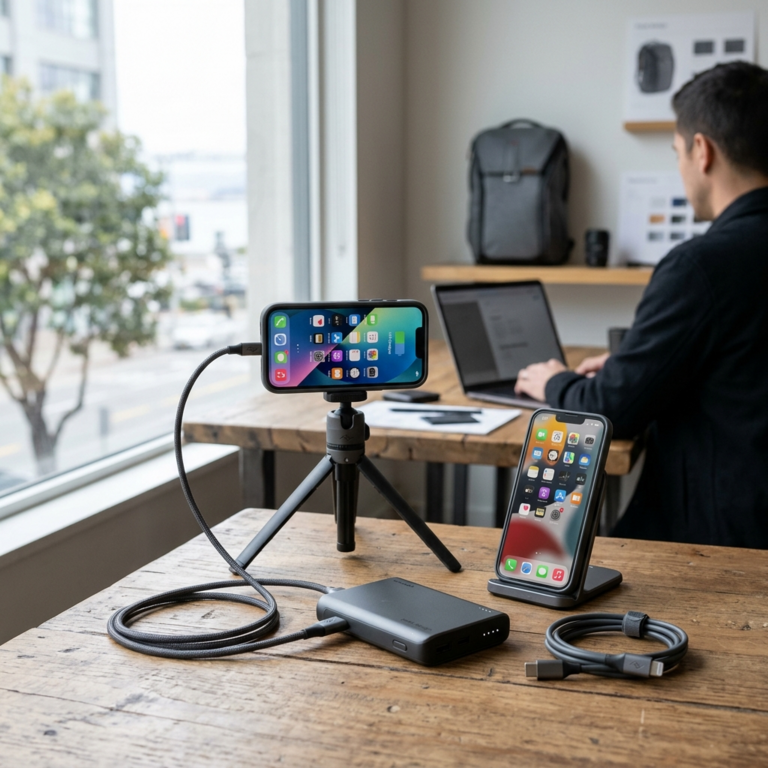
Peak Design’s first collection of smartphone chargers, cables and batteries marks a notable shift for a company best known for the objects that carry and support technology, rather than the electronics that power it. The launch extends a familiar design language into an everyday problem: keeping a phone ready through commutes, workdays and travel. For the brand’s customers, the move feels less like a sudden reinvention than a logical addition to a carefully assembled mobile kit. It also puts Peak Design into a crowded accessory market where utility, reliability and industrial design all compete for attention. The company is betting that people who trust its bags and mounts will want the same considered approach in the small accessories they use daily.
The announcement brings Peak Design into a category with a simple promise and demanding realities: power should be available when needed, without creating clutter or another weak link in a user’s setup. A charger may be a commodity, but differences in size, cable management, portability and durability affect how well it fits into daily life. Batteries also serve different needs, from a quick top-up between appointments to extra capacity on a long trip. Peak Design has not, in the information available, disclosed detailed specifications or pricing for the collection, so its practical advantages will depend on the products themselves, not the brand story alone.
The expansion draws on an ecosystem the company has been building around mobile carry. Its bags and the Tech Pouch are designed to organize everyday gear, including cables, batteries and chargers, while its tripods and phone accessories help people use devices outside the office. Adding power products could make that ecosystem more complete: customers can assemble a single travel or work kit around objects designed to live together. That does not mean every buyer needs a matching set, but it gives Peak Design a chance to address a familiar frustration: the jumble of useful accessories that rarely feels like a coherent system.
For consumers, the key question is whether these products solve real friction better than established alternatives. Portable batteries and charging cables are widely available from electronics brands, phone makers and low-cost sellers, often at prices that make replacement painless. Peak Design’s opportunity is to persuade buyers that thoughtful construction and compatibility with their existing gear justify choosing its accessories. That case will be strongest for travelers, photographers and commuters who already value organized carry, and weaker for people who shop chiefly on charging speed or lowest cost. Clear specifications and dependable performance will matter more than visual polish once a phone is nearly empty.
The move also reflects a broader industry pattern: companies are extending from a flagship product into the connected accessories around it. A bag maker can build loyalty through the way a customer carries a phone; a mount maker can influence how that phone is used; and a power line can help keep it available. For businesses, the benefit is a larger relationship with customers and more opportunities to sell across product categories. The risk is equally clear: stretching a trusted brand into new territory can dilute its reputation if quality control, support or product life falls short of expectations.
Power accessories face practical tests that promotional language cannot settle. Buyers should look for charging standards, supported output, battery capacity, device compatibility, cable durability and warranty terms, then compare those details with their own phones and routines. Airlines also impose limits on the capacity of batteries carried in hand luggage, making clear labeling useful for frequent flyers. Businesses equipping staff have additional concerns, including replacement costs, consistent performance and avoiding a tangle of incompatible chargers. Without confirmed specifications, customers should treat this launch as an invitation to assess the products—not evidence that they outperform established options.
Peak Design’s new collection is significant less because it changes how phones charge than because it shows how far the company wants its design-led carry system to reach. If the accessories prove reliable and sensibly priced, they could turn an existing fan base into a dependable market for everyday power, while giving new customers another entry point into the brand. If they do not deliver on fundamentals, the category’s abundance of alternatives leaves little room for sentiment. Either way, the launch makes a clear bet on the phone as the center of modern mobile life—and on the idea that the gear around it can be as considered as the device itself.