

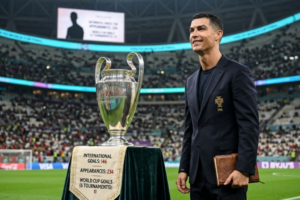





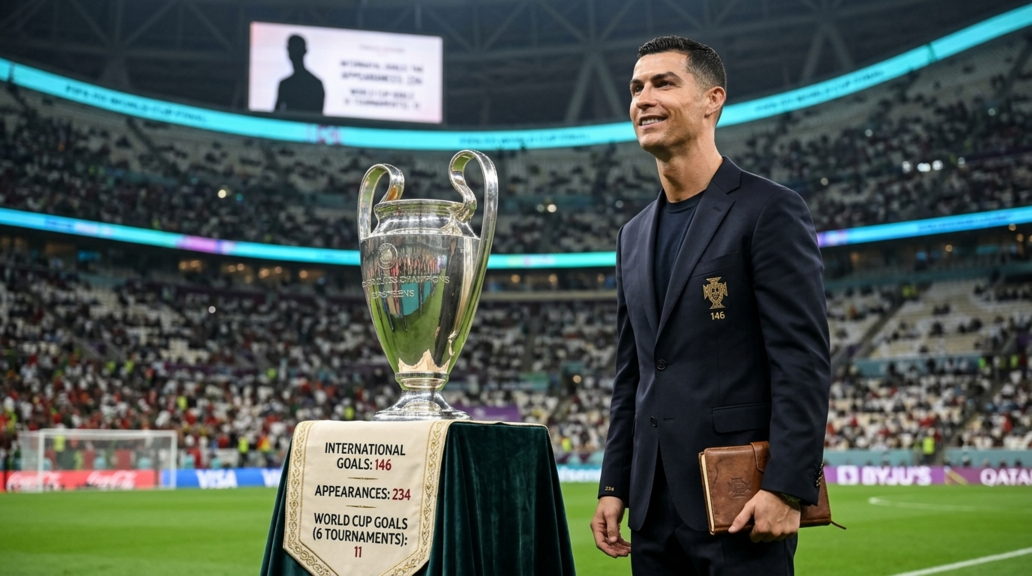
Portugal’s farewell to Cristiano Ronaldo closes a chapter measured in records, but not easily reduced to them. He leaves international football with 146 goals in 234 appearances, figures that place him at the summit of the men’s game and define a generation of expectation around his country. Across six World Cups, from his first in 2006 to his last, he scored 11 times. The total is historic; the more complicated question is what those goals, and the trophy he never lifted, mean to his legacy. For supporters, the numbers carry both pride and an unfinished ache at home still.
Ronaldo’s World Cup story began as a gifted 21-year-old in Germany, when Portugal reached the semifinals and finished fourth. Over the tournaments that followed, he became the first man to score at five editions, a mark of remarkable longevity in a competition that repeatedly refreshes its cast. His sixth appearance extended that span and put another chapter on a résumé built through fitness, ambition and an almost relentless appetite for decisive moments. At every stop, opponents had to account for a forward whose movement and confidence could turn one opening into a headline and alter the match’s mood.
Yet the World Cup offered no clean, triumphant ending. Portugal’s deepest run during his era came in 2006, while later campaigns brought exits before the final weekend and the familiar scrutiny that follows a superstar. Individual brilliance could not erase the limits of a team sport: opponents could crowd him, teammates could miss chances, and a single knockout night could outweigh years of achievement. That tension made every tournament feel like both an opportunity and a verdict, even when the verdict was too simple for a career that stretched across eras, coaches and changing versions of Portugal itself.
His larger international legacy is far broader than the tournament ledger: 146 goals made him the leading scorer in men’s international history, while 234 appearances captured service measured in seasons, not moments. For Portugal, he was at once finisher, standard-bearer and national symbol, the player young fans watched and older supporters argued about. His presence changed the scale of belief: a country accustomed to talented generations could enter major tournaments expecting to contend, not merely participate. That expectation was a burden as well as a gift, and no one carried it more visibly for more than two decades.
His goals arrived in different roles and at different stages: sometimes as the young winger bursting into space, later as the veteran striker whose timing and instinct remained dangerous. Eleven World Cup goals place him among the tournament’s defining scorers, but the number also invites close inspection of the moments that did not become memories of victory. Fans remember the celebrations, the pressure, and the argument over who deserves credit; they also remember the abrupt silence after elimination. That mixture is why his tournament record feels human rather than merely statistical: a long contest with time and expectation.
Retirement cannot settle the debate over whether a player’s greatness requires football’s largest prize. Ronaldo never won the World Cup, and that absence will remain the obvious qualification whenever his international story is told. But a trophy is not the only measure of what a national career gives its supporters: there are records, shared afternoons, and the feeling that one player kept the country in the conversation. Portugal’s eventual success belongs to a team and a new generation, while his long service helped build the platform on which expectations grew. Those truths can coexist without diminishing either too.
At the final whistle of this chapter, the numbers offer a fitting snapshot: six World Cups, 11 goals, 146 international strikes and 234 appearances. They show endurance and production, but also the distance between individual ambition and collective destiny. For fans, his retirement is not a verdict so much as an invitation to remember the full contest: the goals, the disappointments, the noise he brought to every stage. Portugal will move forward without its famous standard-bearer, yet the record he leaves behind will keep his voice present whenever the national team returns to football’s grandest arena.