







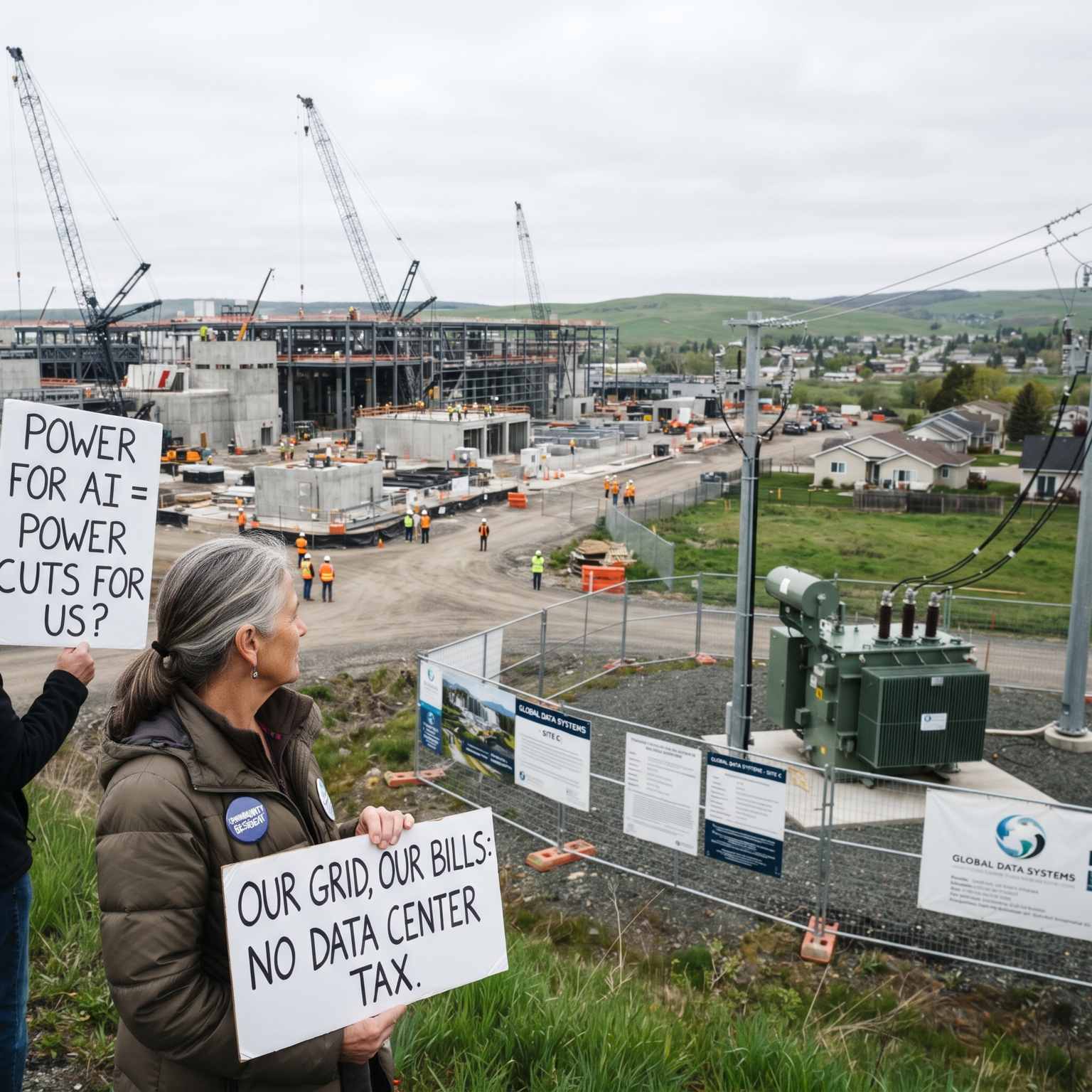
The artificial-intelligence boom is being built not only in software, but in vast data centers packed with servers that train and run AI models. As companies race to secure computing capacity, these facilities are multiplying—and so is a collision over electricity, infrastructure costs and who bears them. Utilities and local officials face requests for power on a scale that can strain existing grids and force expensive upgrades. What looked like a niche planning issue has become a public argument, with consequences for household bills, climate goals and the social license of the AI industry.
AI workloads make the facilities especially power hungry: processors operate continuously, while cooling systems remove heat from dense racks of computing equipment. Training a large model can demand a concentrated burst of electricity, and serving millions of queries creates a persistent load that grows with usage. Unlike many homes or offices, a campus may need power around the clock, sometimes at a scale comparable to a sizable town. Industry projections and individual project plans vary, but some developments are designed around gigawatt-scale peak needs, making grid access a central competitive advantage.
Connecting a new campus is not simply a matter of plugging in: utilities may need substations, transmission lines and generation, investments that take years to permit and build. When construction advances faster than infrastructure, operators can face delays, while power companies negotiate delivery commitments and determine how expansion costs will be recovered. If forecasts prove too optimistic, underused projects may leave customers or shareholders exposed; if demand arrives as promised, postponing upgrades risks bottlenecks and reliability concerns. Those competing risks are now shaping utility plans and regulatory debates, including who should pay when a private technology investment triggers public works.
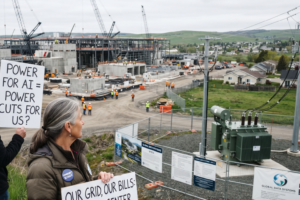
For residents, the dispute becomes tangible when a utility seeks higher rates to finance new capacity, or when a project consumes land, water and public attention. Data-center developers often argue that they bring construction jobs, tax revenue and investment, and that large customers can help justify infrastructure that benefits others. Critics counter that permanent staffing can be modest relative to a facility’s footprint, while residents may see costs rise without receiving equivalent economic gains. The distribution can feel especially unfair if data centers negotiate favorable bulk-power arrangements while households shoulder a share of grid upgrades, a concern raised in communities where projects are proposed.
That tension has moved beyond neighborhood meetings into statehouses and national politics, where energy affordability, industrial competitiveness and climate policy increasingly overlap. Concern is bipartisan: lawmakers who disagree on regulation can still question whether ratepayers should subsidize technology firms, or whether grid capacity should be reserved for homes and domestic industry. At the same time, both parties have reasons to court data-center investment, from jobs and tax receipts to leadership in AI, cloud computing and advanced manufacturing. That makes the debate less a simple yes-or-no referendum than a test of whether rules can align private expansion with reliable, affordable public power.
Companies are exploring several ways to close the gap: long-term power contracts, on-site generation, batteries, more efficient chips and flexible computing that shifts some workloads away from peak hours. Fuel cells and other distributed systems are also attracting attention because they can provide electricity near a campus, although their emissions, fuel supply and cost determine whether they advance climate goals. Renewable-energy purchases can help, but matching clean generation to round-the-clock demand requires storage, transmission and careful accounting, rather than a contract alone. The boom is also widening commercial disputes, including patent lawsuits over technologies supporting data-center operations, as companies compete to own critical components and systems.
For users, the immediate effect may be invisible: faster AI tools and new services depend on infrastructure they rarely see, yet electricity costs can flow through household bills and business budgets. For communities, the key questions are whether costs are transparent, water and land impacts are managed, and promised jobs materialize over the life of the project. Businesses that rely on cloud platforms should expect energy availability and price to become more important factors in where providers build and how they price computing. The AI buildout will continue, but its durable advantage may belong not to whoever secures servers, but to whoever can power them without making the public pay an opaque price.