







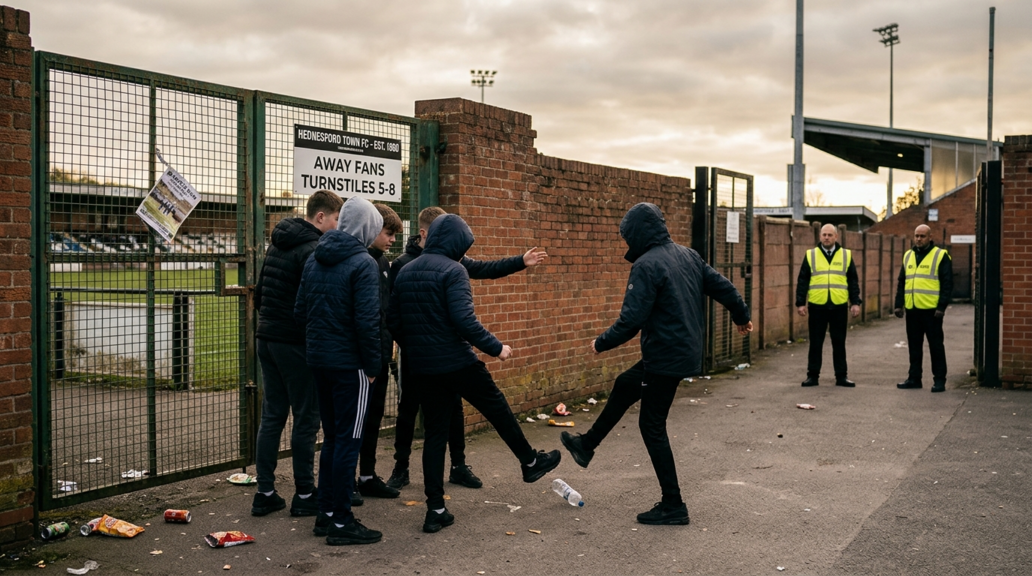
A reported confrontation involving teenage supporters before Hednesford Town’s National League North match in Chester ended without injuries, and the game itself unfolded without trouble. Yet the most unsettling detail came before kick-off: one young person was reportedly seen brandishing a blade. For a sport built on close contact between clubs and their communities, the episode has sharpened an uncomfortable question about who feels safe around non-league grounds. The final score may define the afternoon for players, but the warning signs outside the turnstiles now demand equal attention. That contrast is precisely why the episode matters: a quiet match cannot erase a frightening moment that could have changed lives.
The UK Football Policing Unit has made antisocial behaviour by young people around football a top priority, reflecting concern that isolated incidents may become more serious if left unchecked. The label “schooligans” captures a worrying pattern: youths gathering around matches, sometimes bringing intimidation and disorder into spaces traditionally prized for affordability, local identity and direct access to the game. Non-league football is particularly exposed to the tension because its grounds sit close to neighbourhood life, with modest stewarding resources and supporters often sharing entrances, streets and public transport. That intimacy is part of the appeal, but it also means a confrontation can feel immediate and personal rather than distant from the club.
For Hednesford, the reported incident came on a day when attention should have belonged to the contest in Chester. The Pitmen, as the Staffordshire club is known, compete in the National League North, a demanding level where travel, tight budgets and local backing shape every campaign. Players and coaches prepare for an opponent, a pitch and the pressure of earning points; they cannot be expected to manage risks created by disorder beyond the match itself. The fact that the fixture passed peacefully is welcome, but it should not be mistaken for proof that the danger was insignificant.
The absence of injuries is the clearest relief, especially given the reported presence of a blade. A weapon turns a gathering into a potential emergency in seconds, placing young people, families, stewards and passers-by at risk. No further details about the confrontation have been established here, and responsible reporting must distinguish a reported sighting from a confirmed account of what happened. Still, the possibility alone explains why clubs and police are treating youth disorder as more than a nuisance or a public-relations problem.
There is a difficult balance between protecting the matchday experience and keeping football open to young supporters. Non-league clubs depend on new generations in the stands, and most teenagers attending games do so to follow a team, spend time with friends and enjoy the shared rituals of sport. Blanket suspicion would alienate those fans and do little to address the behaviour of a minority. Effective responses are more likely to combine visible, proportionate policing with communication among clubs, families, schools and local communities, while making clear that weapons and intimidation have no place near a ground.
For supporters, the stakes are practical as well as emotional: a safe journey to the match, confidence bringing children, and the freedom to focus on football rather than scan a crowd for trouble. Non-league grounds offer a closeness to players and clubs that larger stadiums can rarely replicate, but that closeness depends on trust among everyone who shares the space. Stewards and police need support, clear reporting channels and cooperation across matchday routes, not just within the stadium boundary. Clubs, meanwhile, can reinforce expectations and make it easier for young fans to find positive ways into the game.
The Chester fixture will be remembered less for its action on the pitch than for the warning that preceded it. That is an unfair shadow for players and genuine supporters, but ignoring it would be worse. The policing unit’s priority signals that authorities see a pattern worth confronting before a more serious incident forces a response. Football’s smallest grounds are not insulated from wider social pressures; they are often where those pressures become visible up close. The challenge now is to protect the community spirit that makes non-league football matter, so the next gathering of young supporters is defined by chants, colours and competition—not fear.