








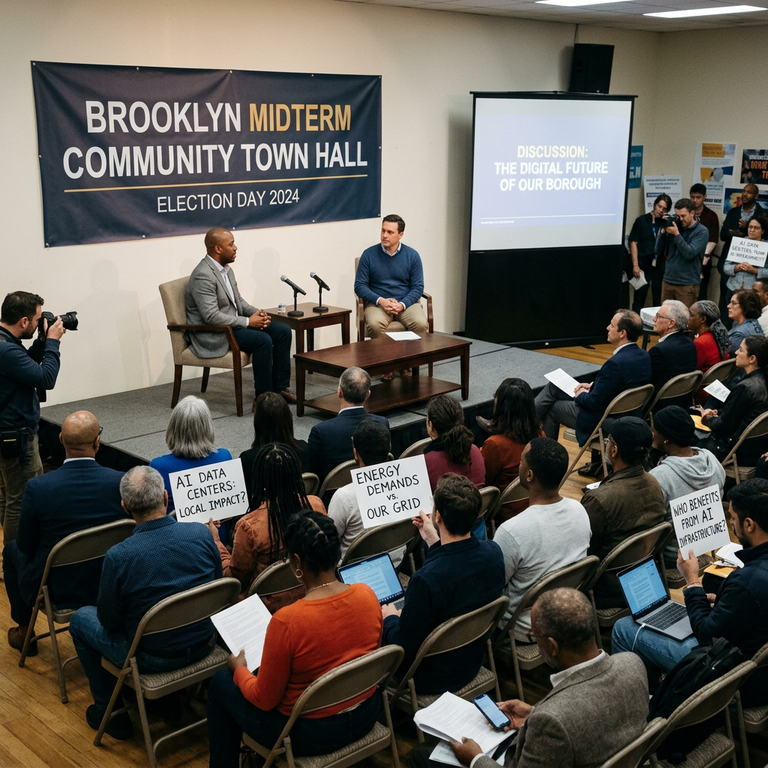
Five days before Election Day, a midterm gathering in Brooklyn offered a familiar campaign soundtrack: conversations about party strategy and local leadership. But across a council member’s fireside chat and a debate over the Democratic Party’s direction, one subject kept resurfacing: artificial intelligence, and the data centers being built to power it. The recurrence matters because infrastructure once treated as a back office concern is now becoming visible to voters as a question of land use, electricity, water, jobs and political accountability. In Brooklyn, as elsewhere, the debate signals that AI’s expansion is beginning to leave technology conference rooms and enter the everyday arena where communities weigh who benefits, who pays and who gets a say. The gathering did not settle those questions, but its agenda showed how quickly a technical buildout can become a local campaign issue, locally.
A data center is, in simple terms, a large facility packed with computers that store information and perform calculations. AI systems, particularly those that generate text, images or code, can require enormous computing capacity, and that capacity depends on buildings, servers, cooling equipment and reliable power. As companies race to develop and deploy AI products, demand for these facilities is growing, putting infrastructure decisions in the path of local governments and residents. The Brooklyn discussions reflect a shift: voters are not only hearing promises about futuristic software, but asking what must be constructed nearby to make it work. That shift gives an abstract technology a physical footprint, one that can be examined through familiar questions about neighborhood change, public resources and corporate responsibility.
The political stakes are practical. A proposed facility may bring construction work, tax revenue and investment, yet it can also intensify competition for electricity and require substantial cooling. The consequences depend on the site, the project’s design, the local grid and the terms negotiated with public officials; the event account does not establish that any particular Brooklyn project was under discussion. Still, the questions raised by data centers are increasingly relevant wherever communities face decisions about large infrastructure. Residents may want to know whether promised jobs will last beyond construction, whether utility upgrades will be publicly funded, and how water and energy use will be measured. Those are not objections to AI itself so much as demands to make its costs and benefits legible.
For technology companies, that scrutiny could change how expansion works. Data centers are not easily deployed like a software update: they need land, equipment, grid connections and long planning timelines. If local opposition, permitting delays or power constraints complicate projects, developers may have to explain their plans earlier, choose sites more carefully and work more closely with utilities and communities. That does not mean every project will be blocked, or that public debate alone can resolve shortages. It does mean that a company’s infrastructure strategy may increasingly depend on public trust, alongside access to capital, chips and electricity. Community engagement could become a condition of speed rather than a public relations exercise after decisions have already been made.
The issue also complicates the usual political divide over technology. AI can be presented as a source of productivity and economic leadership, while its supporting infrastructure raises concerns that cross party lines: household power costs, environmental effects, local control and whether economic gains are shared. A campaign conversation that moves between party identity and data centers shows how voters can connect national technology ambitions to neighborhood consequences. That connection may prompt candidates to take positions on permitting, utility planning, transparency and incentives, even when the underlying systems are technically complex. It also challenges officials to distinguish evidence based concerns from sweeping claims, and to explain tradeoffs in terms residents can evaluate.
For users, the connection can feel indirect: asking an AI assistant a question does not reveal the servers behind the reply. Yet the services consumers and businesses increasingly rely on are shaped by the cost and availability of computing infrastructure. More data center capacity can support faster services and wider access to AI, while constrained electricity or expensive construction can affect where companies build and how they price products. Businesses adopting AI should therefore watch not only model performance, but also the energy, reliability and infrastructure assumptions behind the services they buy. For households, local decisions may matter through utility planning and public spending, even if a data center never appears on their block. The infrastructure is part of the product, even when users cannot see it.
Brooklyn’s midterm gathering offers an early glimpse of a broader political adjustment: AI is no longer only a discussion about algorithms, jobs or online misinformation. Its physical requirements are turning into questions of civic choice, and those questions will grow as companies seek the power and space needed to scale. The next phase of the debate should be grounded in project level disclosure, credible estimates of resource use, clear accounting of public costs and benefits, and meaningful opportunities for residents to participate. None of that guarantees consensus; it can, however, make disagreements more concrete than slogans about innovation or disruption. For voters, the key question is not simply whether AI will transform society, but who will shape the infrastructure that makes that transformation possible, and on what terms.