









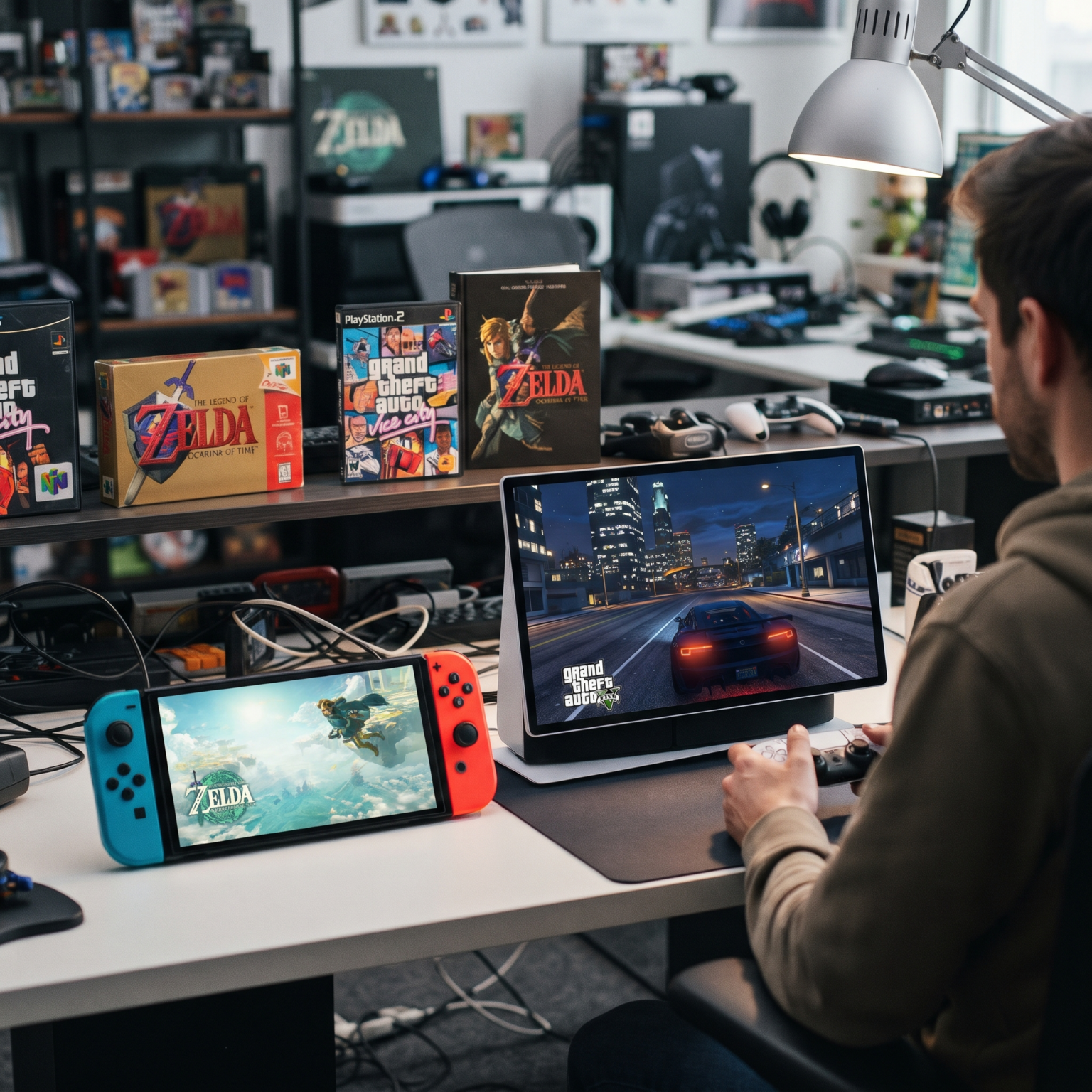
For years, a new Zelda and a new Grand Theft Auto would have been measured by familiar yardsticks: bigger worlds, sharper graphics and more elaborate stories. The latest generation of releases points to a different contest, one over how much freedom players expect, how long games can hold attention and what studios must spend to deliver them. Nintendo’s open-world Zelda experiments and Rockstar’s sprawling crime saga occupy very different creative territories, yet both reveal an industry reshaped by blockbuster economics and changing audiences. Their significance is not simply that millions will play them; it is that their design choices help set expectations for nearly every game that follows.
The older model of a sequel was straightforward: preserve the winning formula, then add levels, enemies and spectacle. Zelda: Breath of the Wild challenged that logic by making exploration, improvisation and systemic interaction central, rather than treating a sequence of dungeons as the whole experience. Its world invites players to climb, experiment with physics and approach obstacles in multiple ways, turning curiosity into a core mechanic. That shift widened the series’ audience while prompting debate among longtime fans about whether openness had displaced the tightly authored puzzles and rhythms they loved.
Grand Theft Auto’s appeal rests on a different promise: a densely observed world where missions, characters and unpredictable encounters create the feeling of inhabiting a crime drama. Rockstar’s approach is expensive and labor-intensive, with cinematic presentation and detailed simulation demanding years of production and teams numbering in the thousands across art, animation, writing, technology and testing. A release of this scale can become a cultural event, but also a commercial bet whose cost makes publishers cautious about risk elsewhere and extended development cycles. That tension is increasingly visible: players want worlds that feel alive, while companies need a rare hit powerful enough to justify enormous budgets in a crowded market.
Together, these games illustrate how the blockbuster has changed from a product sold once into a platform for sustained attention. Open-ended worlds can keep players exploring after the main story, while online modes, updates and downloadable additions offer reasons to return. Such longevity can deliver more value to players, but it also encourages publishers to compete for time long after launch. For consumers, the practical question is no longer just whether a game is good; it is whether its scale, price and ongoing demands fit the way they want to play.
That shift has consequences beyond the biggest releases. Smaller studios often cannot match vast maps, photorealistic detail or years of post-launch support, so their advantage increasingly lies in distinctive ideas, focused experiences and lower prices. Yet blockbuster expectations can shape what audiences consider acceptable, raising pressure on every game to look enormous or offer endless content. Nintendo’s success with playful experimentation suggests another route: a systemically rich design can feel expansive without relying solely on realism. The industry’s future may depend on preserving that range, rather than making every project imitate the most expensive hits.
Technology is part of the story, but better hardware alone does not explain the change. Faster storage, powerful consoles and improved development tools let designers build larger spaces and make them more responsive; they also raise expectations for polish and complexity. Meanwhile, digital distribution makes updates easier, and subscription services give players more options while intensifying competition for their attention. These shifts can improve access and enrich games, but they make launch quality and transparent communication more important: audiences are less forgiving when a premium release arrives unfinished or relies on promises of later fixes.
The new Zelda and GTA therefore represent more than two eagerly awaited brands; they are tests of what players will reward in an industry under financial and creative strain. One emphasizes discovery and flexible problem-solving, the other immersion in a meticulously staged world, but both ask audiences to invest substantial time. Their reception will influence how publishers weigh experimentation against familiar franchises, and how much content they believe a premium game must contain. For players, the best outcome is not simply bigger games, but more meaningful choices: worlds worth exploring, stories worth following and experiences that respect both their time and their money.