









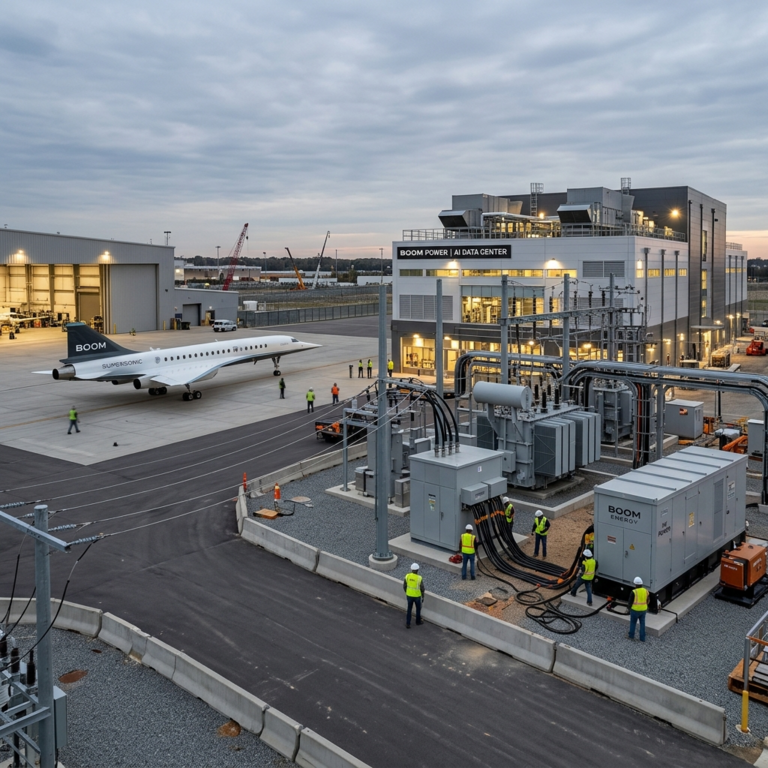
Boom Supersonic has spent years promising a return to passenger supersonic flight: a future in which travelers could cross oceans in roughly half the time required by conventional jets. Now the Colorado company is broadening its ambitions, developing gas turbines intended to supply electricity to AI data centers, where demand for reliable power is rising quickly. The shift could give Boom another route to revenue, but it raises a difficult question: can the company advance two capital-intensive businesses without delaying its airliner? That question is more pressing after the power effort lost a customer, adding uncertainty to a strategy presented as a potentially important new business.
Boom’s aviation vision centers on Overture, a proposed supersonic passenger aircraft designed to carry travelers faster than today’s commercial planes. The concept addresses a persistent appeal of air travel: saving hours on long-haul journeys, particularly for business travelers and passengers willing to pay a premium. But an aircraft is not just a striking design; it must meet demanding safety and environmental requirements, attract airline buyers, and be built at a cost that supports commercial service. Those hurdles make timelines and funding central to whether Overture can move from promise to passenger routes.
The turbine program speaks to a different, immediate pressure in technology: artificial intelligence is driving the construction of data centers that consume enormous amounts of electricity. Operators need dependable power to keep computing equipment running, and the grid can struggle to deliver new capacity quickly enough. Boom has unveiled a Colorado factory dedicated to producing gas turbines for this market, applying its engineering expertise to equipment rather than aircraft. The opportunity is substantial, but so is competition from established energy suppliers and other companies seeking to serve power-hungry computing campuses.
For Boom, selling turbines could diversify income while its aircraft development proceeds, and might put its manufacturing capabilities to work sooner. Yet the two businesses are not automatically complementary: they require capital, staff, supply chains, customers, and management attention. A lost customer does not establish that the turbine market has disappeared, but it does weaken the certainty of near-term demand and makes execution more consequential. Without a durable pipeline of buyers, factory investment may be harder to justify, while redirecting resources could complicate progress on aviation.
That tension matters because aerospace development is famously expensive and slow. A commercial aircraft must pass extensive testing and certification, while airlines need confidence that it can be maintained, operated safely, and supported with parts over decades. Supersonic flight also faces distinctive constraints, including noise concerns and restrictions on routine travel faster than sound over land in many places. Even if the aircraft performs as intended, route availability, ticket prices, fuel use, and public acceptance will shape whether faster journeys become a viable service rather than a niche attraction.
The power pivot reflects a broader technology trend: companies built around one breakthrough increasingly seek adjacent markets where their engineering can meet urgent demand. AI infrastructure has made electricity a strategic bottleneck, prompting data center operators to consider new generation sources and long-term energy agreements. For communities, that investment can mean industrial jobs and tax revenue, but also questions about emissions, water use, grid capacity, and who pays for upgrades. Gas turbines can provide dispatchable power, yet their climate impact depends on how they are fueled and operated, making the details more important than the AI label.
Consumers should therefore see Boom’s shift neither as proof that supersonic travel is over nor as evidence that AI power will rescue it. The practical test is whether the company can secure customers, deliver turbines, and preserve the people and funding needed to advance its aircraft. Businesses watching the story face a familiar lesson: a hot market can offer diversification, but a promising opportunity is not a substitute for firm contracts or disciplined execution. Boom’s next decisions will show whether its energy ambitions strengthen its aviation bet, or become a competing priority that postpones the faster future it set out to build.