







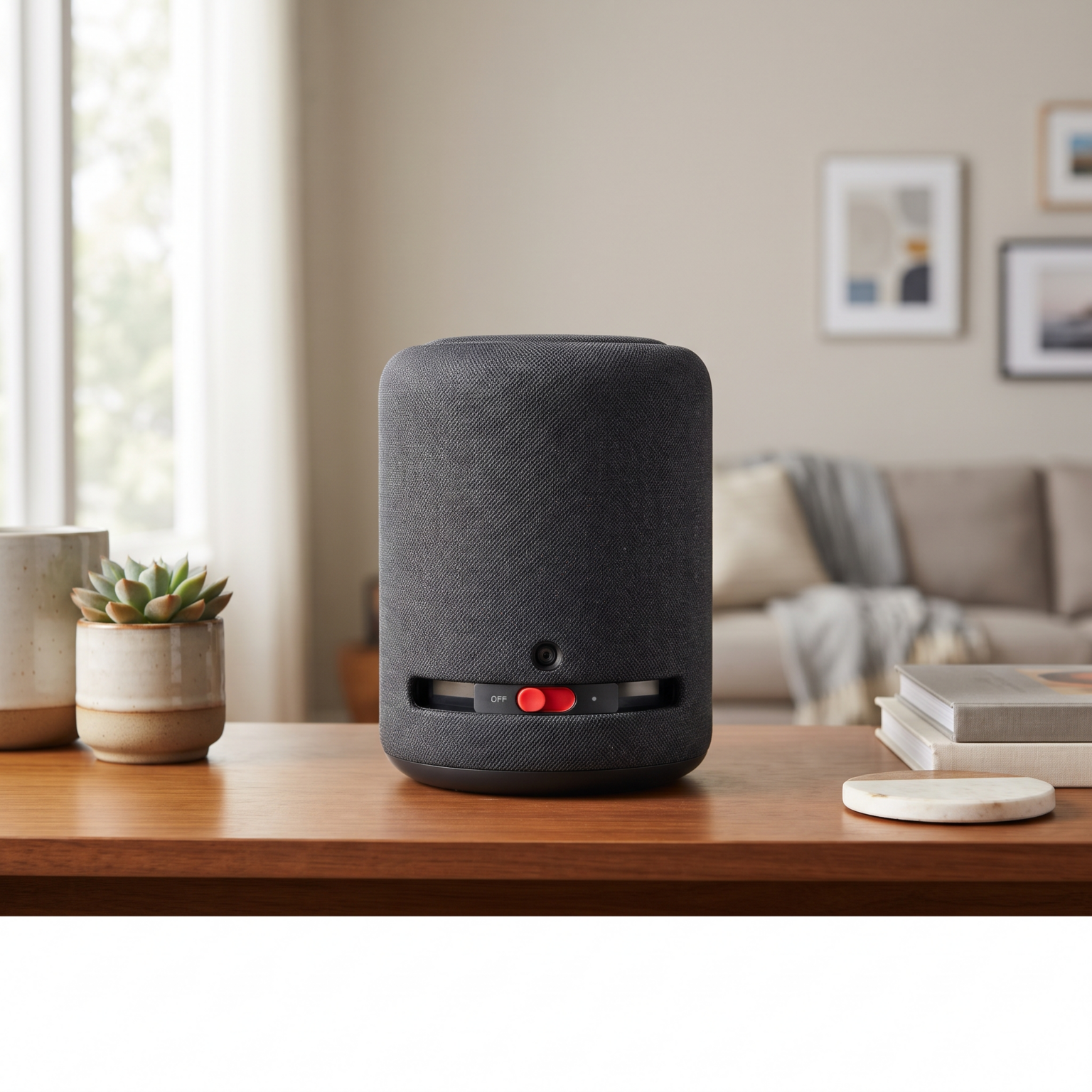
Amazon is turning the smart speaker into a more observant household device. Its new Echo Studio with Home Camera, priced at $249.99, adds a camera that lets Alexa+ use visual input alongside spoken requests. The assistant can recognize objects held in front of the lens, while remote room viewing lets owners check a space when away. The pitch is not simply better sound or faster answers: it is an assistant able to interpret more of the scene around it. Amazon has also kept the camera-free Echo Studio on sale, giving customers a choice between the new capability and a familiar, less visually intrusive speaker. That distinction may prove as important as the camera itself.
The change reflects a broader evolution in voice assistants, which have traditionally depended on users describing what they need. A camera can supply some of that context directly: Alexa+ might identify an object shown to it or help a user inspect a room remotely, rather than relying only on a spoken description. In practical terms, visual input could make household interactions more natural, especially when someone does not know the name of an item or wants to see whether a room is as expected. Amazon has not, in the supplied product details, promised unlimited scene understanding, and recognition should not be mistaken for human-level perception. Still, moving an assistant from listening to seeing marks a consequential product shift.
Putting that capability in a speaker rather than a display also broadens where Amazon can place AI inside the home. A screen-based device invites people to look at it; a speaker is more likely to sit unobtrusively on a shelf, where its camera may capture a wider view of ordinary domestic life. That could make visual assistance convenient, but it also raises a sharper privacy question: people may not think of an audio-first product as a camera. Amazon says the device includes a kill switch for users who want to disable the camera. A physical control can make privacy choices more legible than a buried software setting, though buyers will still want to understand when the camera is active, how video is accessed, and what data is stored.
Remote room viewing is among the most immediately understandable uses, but it changes the device’s role from conversational companion to a potential home-monitoring tool. That may appeal to people checking a room while traveling or keeping an eye on a household space, yet it also means security matters as much as convenience. A camera connected to an account and network needs clear access controls, reliable authentication, and transparent handling of recordings or live feeds. The available information does not establish every safeguard or data-retention policy, so those details deserve scrutiny before consumers treat the speaker as a security camera. The kill switch addresses whether the lens can operate; it does not, by itself, answer every question about digital access and data governance.
The $249.99 price positions the camera-equipped Studio as a premium smart speaker, while the continuing availability of the camera-free model creates a notable choice within Amazon’s own lineup. For shoppers, that makes the trade-off tangible: pay for visual features and accept a camera in the room, or keep the established audio experience without one. For Amazon, the strategy can extend Alexa+ into more rooms without requiring every customer to buy a screen. It also gives the company a way to differentiate a speaker in a crowded market where audio quality and voice controls alone are increasingly familiar. The decision will depend on whether users find seeing genuinely useful enough to justify the added cost and privacy considerations.
The launch also fits a larger industry push to make AI assistants multimodal, meaning they can work with more than one kind of input. Text, speech, images and video can each provide clues, and combining them may help systems respond to requests that are difficult to express precisely. A person could show an assistant an unfamiliar object instead of searching for words, for example. But a camera does not automatically make an AI accurate: lighting, camera placement, ambiguous objects and mistaken interpretations can all limit usefulness. Consumers should expect a feature that helps with specific tasks, not an infallible observer capable of understanding everything happening at home. The quality of explanations, controls and corrections will shape whether visual intelligence feels helpful or unsettling.
For businesses, the product signals that smart-home hardware is becoming a delivery channel for AI services, not just a collection of connected gadgets. Amazon can use its installed base of Echo devices to normalize new assistant capabilities, while the optional camera-free model acknowledges that trust cannot be assumed. The broader stakes reach beyond one speaker: as cameras and AI become routine in domestic devices, companies will need to make consent, security and limits visible at the point of use. Users, in turn, will have to weigh convenience against the intimacy of allowing an assistant to perceive their surroundings. The new Echo Studio offers a glimpse of that future, but its success may hinge less on what Alexa can see than on whether people feel firmly in control of the view.