








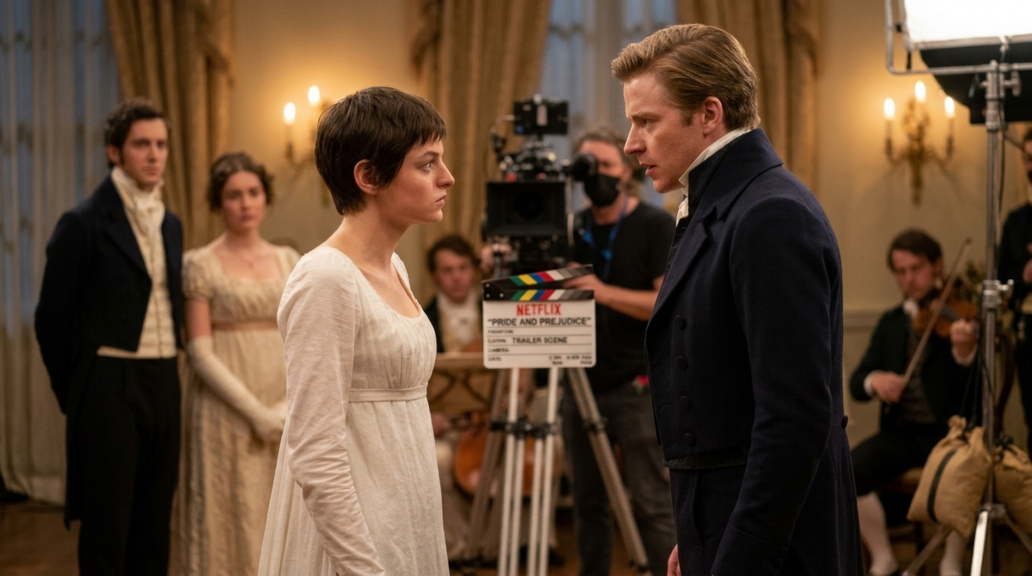
Netflix has released the trailer for its six-part adaptation of Jane Austen’s “Pride and Prejudice,” placing Emma Corrin and Jack Lowden at the center of one of literature’s most enduring romantic contests. Corrin plays Elizabeth Bennet, the quick-witted second daughter whose judgments are as sharp as her social observations; Lowden is Fitzwilliam Darcy, the wealthy, reserved gentleman she initially considers proud. The limited series traces their passage from mutual antagonism toward love, a familiar arc whose pleasures depend less on surprise than on watching two characters revise what they think they know. For viewers, the first footage offers an invitation back to Longbourn, while signaling that Netflix intends to make Austen’s manners, misunderstandings and emotional stakes feel vivid for a new audience.
Published in 1813, Austen’s novel turns courtship into a study of class, money, reputation and the stories people tell themselves. Elizabeth’s lively independence and Darcy’s guarded pride have made them templates for romantic leads, but the book’s humor also exposes the limited choices available to women whose security depended on marriage. That tension gives the romance its lasting charge: attraction is never detached from questions of status, family obligation or personal judgment. A six-episode format gives the adaptation room to let those pressures accumulate rather than compress every turn into a feature-length courtship. That extra space can deepen supporting characters, whose choices often shape the Bennets’ prospects as much as the central pair’s.
Olivia Colman joins the cast as Mrs. Bennet, Elizabeth’s energetic mother, adding a celebrated comic performer to a story whose domestic scenes are inseparable from its romance. Mrs. Bennet’s anxiety about marrying off her daughters can play as farce, but it also reflects the economic vulnerability Austen places beneath the family’s bustle. That blend of wit and unease is central to the novel’s appeal, and Colman’s presence may help the series balance broad humor with genuine tenderness. For longtime readers, the casting suggests a family portrait as carefully considered as the central pairing, not merely a backdrop for Darcy and Elizabeth, whose sisters and parents each embody distinct hopes and pressures.
The challenge for any new “Pride and Prejudice” is to honor a familiar story without making it feel like a museum piece. Its social rules may seem distant, yet the novel’s concerns—snap judgments, self-respect, family expectations and the difficulty of admitting error—remain readily recognizable. Elizabeth and Darcy’s attraction works because each must confront a mistaken first impression, a dynamic that gives the romance emotional movement beyond elegant costumes and country-house scenery. The series can therefore speak both to Austen devotees, who know every turn, and to newcomers discovering why this particular love story has survived for more than two centuries.
The trailer’s central promise is the pairing itself: Corrin and Lowden must make the characters’ friction convincing before viewers can believe in their tenderness. Corrin, known for playing Princess Diana in “The Crown,” brings experience inhabiting a celebrated historical figure; Lowden’s screen work includes “Slow Horses” and “Dunkirk.” Their casting gives audiences fresh faces in roles previously carried by a long line of performers, while inviting comparisons that are part of the fun of adapting a classic. A trailer cannot settle whether their chemistry will sustain six episodes, but it can set the tone and give fans their first glimpse of the interpretation taking shape.
That anticipation also reflects a wider streaming-era strategy: recognizable literary properties offer platforms an established audience, while limited series create space for detailed storytelling. For Netflix, Austen supplies both a globally known title and characters whose appeal crosses generations; the six-part structure can encourage viewers to spend time with the Bennet family rather than treat the romance as a single-night event. Such adaptations are not guaranteed hits simply because their source material is beloved. They must compete for attention in a crowded market, and a distinctive cast and point of view can help a familiar property feel like an event instead of another retelling.
For fans, the new trailer offers a chance to revisit beloved characters and debate how this version will handle their wit, pride and gradual recognition of one another. For general viewers, it provides an accessible entry into a classic whose ideas are easier to approach when embodied by performers and shaped as an unfolding drama. The adaptation’s larger cultural value will depend on whether it makes Austen’s sharp observations feel alive, not simply whether it reproduces a famous romance. Corrin and Lowden now step into roles that carry both affectionate expectations and decades of screen history; Netflix’s six-part series has the opportunity to make that inheritance feel fresh again.