







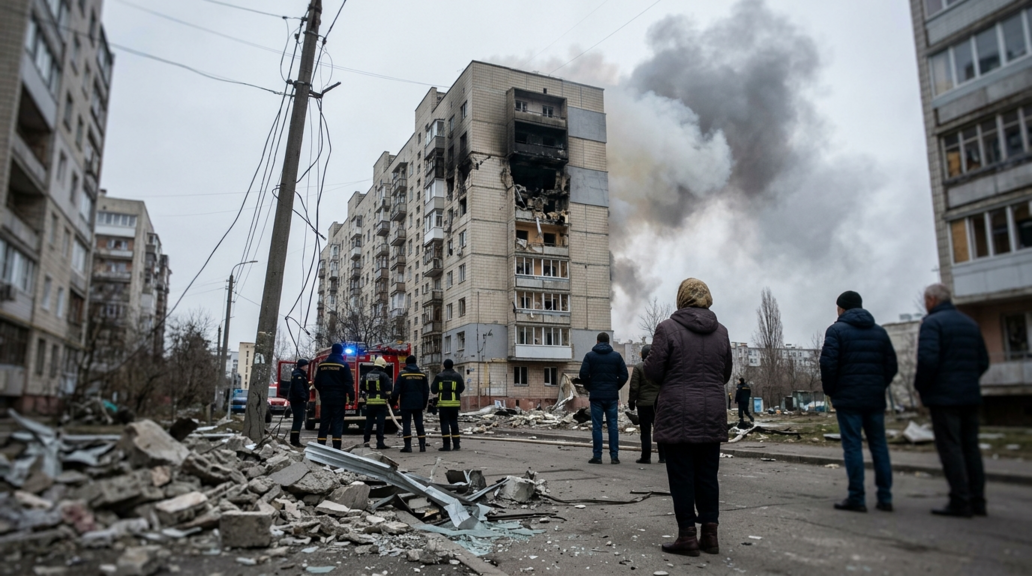
Russia’s missile attack on Kyiv, launched while diplomatic conversations were under way, is a brutal reminder that sovereignty is not secured by communiqués alone. When a government directs explosives at energy infrastructure and civilian neighbourhoods, it seeks not merely military advantage but the exhaustion of a society: darkened homes, interrupted work and families forced to calculate whether ordinary life can continue. Negotiations matter, but talks without deterrence can become theatre in which an aggressor gains time while defenders are urged to accept vulnerability as realism. The first conservative duty is to name the distinction plainly: peace is desirable, yet peace imposed by intimidation is submission with a gentler label.
The attack also exposes a truth too often obscured by fashionable theories of international dependence: nations, like households, must retain the capacity to protect what they cherish. Ukraine’s power stations are not abstractions on a strategic map; they supply heat, hospitals, workshops and the routines through which a community holds together. Resilience depends on trained citizens, reliable infrastructure, secure supply chains and the resolve to defend the rule of law. A country that cannot sustain itself in a crisis is left bargaining from weakness, however elegant its diplomatic language.
That lesson has domestic implications for Britain. A strong state is not the same thing as an ever-expanding state: government’s essential tasks include defence, justice and the protection of citizens, while prosperity is chiefly made by people free to build, trade and innovate. Excessive regulation can leave energy investment waiting on paperwork, infrastructure delayed by process and small firms spending their evenings deciphering rules instead of serving customers. The answer is not indifference to security, but a capable government that concentrates on core duties and clears obstacles to enterprise.
The contrast is visible in the way societies respond to pressure. An entrepreneur who finds a new supplier, a family that prepares carefully, or a local volunteer who checks on an elderly neighbour may seem far removed from missile defence; in fact, each strengthens the networks that make a nation harder to coerce. Personal initiative is not a substitute for public institutions, but it is their indispensable partner. Policies that reward work, saving and investment help create self-reliant citizens, rather than treating every difficulty as a warrant for central control.
The economic case is practical as well as moral. Capitalism channels dispersed knowledge into decisions about what to make, where to invest and how to improve; the price signal can adjust faster than a committee issuing instructions from afar. Lower burdens on work and investment, predictable rules and room to experiment give British firms a better chance to hire, expand and develop the technologies on which modern security depends. No minister can decree prosperity, and no spending announcement can conjure productive capacity where incentives have been smothered.
Brexit was an assertion that political responsibility should sit closer to the electorate, not a guarantee that independence would automatically deliver renewal. Its promise is fulfilled only when Britain uses its freedom to pursue sensible trade, nimble regulation and competitive energy, while accepting accountability for the consequences. Sovereignty means the ability to make choices, including difficult choices about defence and national resilience; it cannot mean retreating from allies or pretending geography has changed. The proper response to aggression is cooperation among free nations, not the surrender of democratic judgment to distant bureaucracies.
Conservative values give this argument its human scale. Families need safety and opportunity; communities need stable institutions, voluntary service and a culture that honours duty; businesses need the rule of law and room to take risks. These goods are undermined both by foreign aggression and by domestic policies that weaken initiative, burden productive work or mistake dependency for compassion. Kyiv’s ordeal should sharpen Britain’s priorities: defend liberty with resolve, strengthen the foundations of prosperity, and trust citizens to do their part. A free nation is most secure not when the state attempts everything, but when government protects the space in which families, communities and enterprise can flourish.