








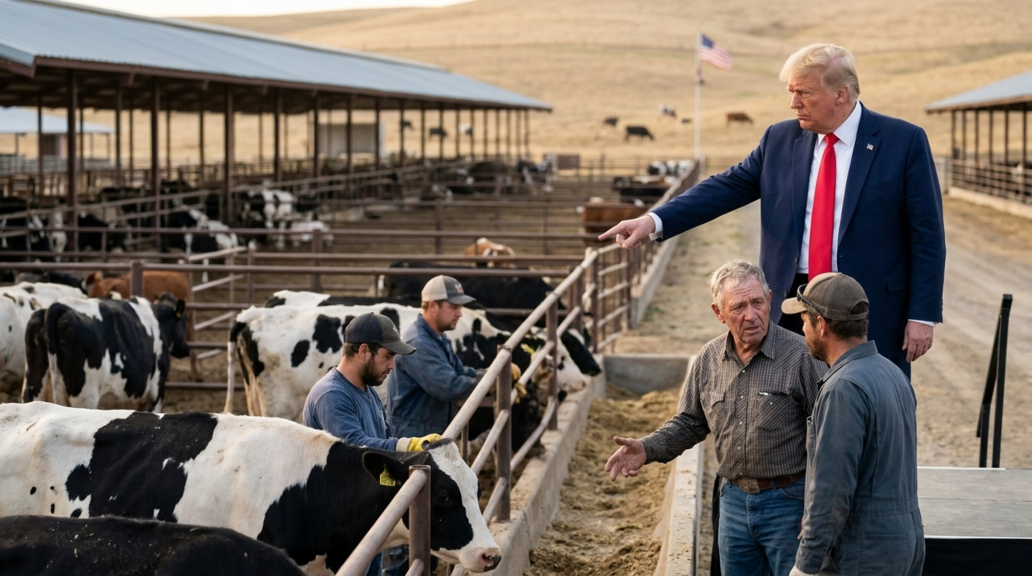
America’s cattle and dairy producers are confronting a problem Washington should have anticipated: farms cannot keep food moving when skilled labour is treated as an afterthought in an enforcement campaign. Farmers and industry groups warn that the immigration crackdown is shrinking the workforce, complicating milking and animal care, and putting pressure on domestic supply. When a herd contracts, recovery takes years, not a news cycle; consumers eventually see the consequences at the meat counter and checkout. This is not an argument against enforcing borders, but for matching enforcement with rules that let essential enterprise function.
A conservative case begins with an unromantic fact: food production depends on people, capital, land and predictable law. Cattle ranching and dairy farming are demanding businesses, with work that cannot simply be paused until a vacancy is filled. If producers cannot hire reliably, they may reduce herds, delay investment or leave the market; fewer animals today can mean less beef tomorrow. Washington should take seriously the Labor Department’s warning that labour costs and worker shortages could raise food prices, especially for households already managing tight budgets.
That outcome would be a policy failure, not proof that markets have failed. Prices convey scarcity, but government should not create scarcity by abruptly disrupting the workforce on which domestic production relies. Nor should consumers be asked to subsidise a system whose rules make lawful hiring needlessly uncertain. Enforcement matters: a sovereign country must know who enters and work must be legal, but a functioning border policy needs practical channels for employers to recruit, verify and retain workers under clear conditions.
The answer is neither open borders nor a permanent pool of precarious labour. Congress should establish a targeted agricultural work programme with rigorous identity checks, employer accountability, protection against exploitation and a route for workers to return home when contracts end. It should also modernise visa processing, publish dependable timelines and consult producers before enforcement changes take effect. Such reforms would make the law more credible, give farms a stable workforce and help ensure that the benefits of enterprise are not lost to paperwork or sudden regulatory shocks.
Longer term, government should welcome investment in machinery, processing technology and better training, while resisting the instinct to regulate every adjustment from Washington. Automation can ease repetitive tasks, but it is not an instant substitute for experienced hands tending animals or managing a ranch. Small and family farms, in particular, need room to test new methods and access capital without being buried under compliance costs. Lower barriers to investment and a tax system that rewards expansion would help American agriculture become more productive, resilient and competitive.
The wider principle is familiar to conservatives: prosperity grows when people can work, build and take responsibility within a stable framework. A family farm is not merely a line in a national accounts table; it is a source of local employment, stewardship and civic continuity. Yet traditional virtues cannot thrive if political leaders treat working people as disposable or assume that every economic problem requires another federal programme. Personal initiative deserves respect, and so does the farmer’s practical knowledge of what it takes to get food from pasture to plate.
Brexit offered Britain a reminder that sovereignty is valuable when it permits better choices, not when it becomes a slogan detached from consequences. America likewise has the authority to secure its borders and the responsibility to protect the conditions under which its producers can supply the nation. A serious conservative settlement would enforce the law, make legal hiring workable, reduce needless bureaucracy and let competition encourage innovation. The test is not whether government sounds tough, but whether farms remain viable and families can afford the food they depend on.