






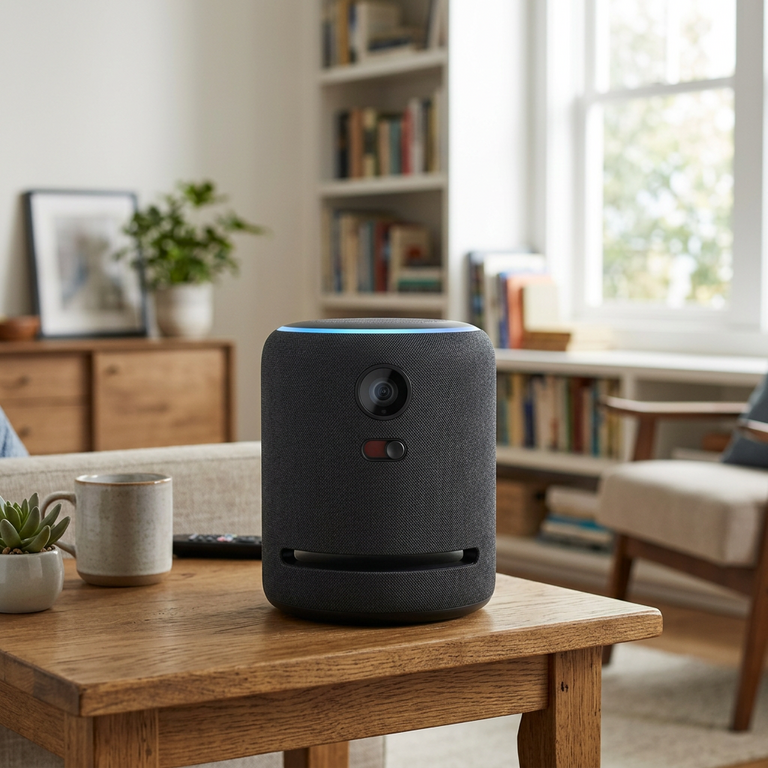
Amazon is giving its premium Echo Studio a new role in the connected home: a built-in camera lets Alexa+ respond not only to spoken requests but also to visual information from indoor spaces. On paper, the change sounds modest, yet it marks a meaningful turn for the smart speaker, a category long defined by microphones, sound quality and hands-free control. Amazon describes the Echo Studio with Home Camera as its best Alexa+ speaker, positioning vision as an added layer to an established assistant rather than a separate security gadget. That distinction matters: the company is testing whether an assistant can make a room’s visible context as useful as its voice interface has been for everyday questions, routines and household tasks, without requiring a screen or phone at all.
The camera’s significance lies less in recording than in interpretation. Amazon says Alexa+ can use visual intelligence to interpret what the camera sees, bringing image-based awareness into interactions that previously depended on a user describing the scene. That could make an assistant more helpful when someone asks about an object, a household situation or a task unfolding nearby, although the precise capabilities and limits will determine whether the feature proves useful beyond a demonstration. Vision gives software a second input channel: instead of waiting for a spoken description, it can potentially ground a response in the surroundings, much as people naturally combine sight and language when navigating homes and making ordinary decisions. But visual confidence should not be confused with reliable understanding.
The move also reflects a broader industry race to make AI assistants more aware of their surroundings. For years, smart speakers have been convenient but constrained: they could play music, answer questions and control compatible devices, yet often needed exact commands and had little context about what was happening in a room. Generative AI has raised expectations for more flexible conversation, and adding a camera offers a path to richer exchanges. The Echo Studio’s audio focus is relevant here, because Amazon is putting visual sensing inside a familiar, premium speaker rather than requiring a phone or dedicated display. That may make camera-enabled assistance feel like a natural next step, even as it changes what consumers think a speaker is.
For households, the practical promise is convenience, not simply novelty. A visual assistant might help users make sense of nearby items or situations without picking up a device, and could eventually support more contextual home routines. Such benefits depend on accurate interpretation, quick responses and clear boundaries around when the camera is active; a mistaken answer about an object or activity could be more frustrating than no answer at all. The product description establishes visual understanding, but does not by itself settle how well Alexa+ performs across different lighting, clutter or household layouts. Users should therefore judge the feature by its everyday reliability, rather than assuming that a camera automatically makes an assistant perceptive.
Privacy is the central test for a device that brings a lens into shared living space. Amazon includes a physical kill switch that lets users disable the camera, a tangible control that is easier to understand than a software setting buried in an app. Its presence acknowledges the tension between useful context and the feeling of being watched, especially in bedrooms, family rooms or homes with guests. A switch can reassure people who want visual features sometimes but not constantly, although confidence will also depend on clear indicators, accessible controls and straightforward explanations of data handling. Households need to know when sensing is available, what information is processed and whether anything is stored or shared, not merely that a camera can be turned off.
The design raises questions for businesses and the wider smart-home market, too. Amazon has spent years building Alexa into speakers, screens and connected-home services; adding vision could increase the value of that ecosystem and give customers another reason to choose its hardware. Competitors face pressure to show that their assistants can do more than respond to commands, while device makers must weigh the cost and privacy burden of adding sensors. A camera-enabled speaker may also blur familiar product categories: it is part audio system, part assistant and potentially part home-monitoring device. That convergence could encourage more capable products, but it also makes transparent settings and consistent privacy standards increasingly important across the industry.
The larger shift is from assistants that wait for instructions to systems designed to interpret context. That ambition could make technology feel less like a collection of apps and more like an adaptable household helper, particularly for people who benefit from hands-free interaction. Yet a home is not a neutral computing environment: family members, visitors and children may not all agree to camera use, and a device’s mistakes can affect people who never chose to buy it. Amazon’s physical switch is a useful safeguard, but trust will be earned through dependable performance and meaningful user control over time. The Echo Studio with Home Camera is therefore both a product and a test: whether visual AI can become genuinely helpful at home without making privacy the price of convenience.