







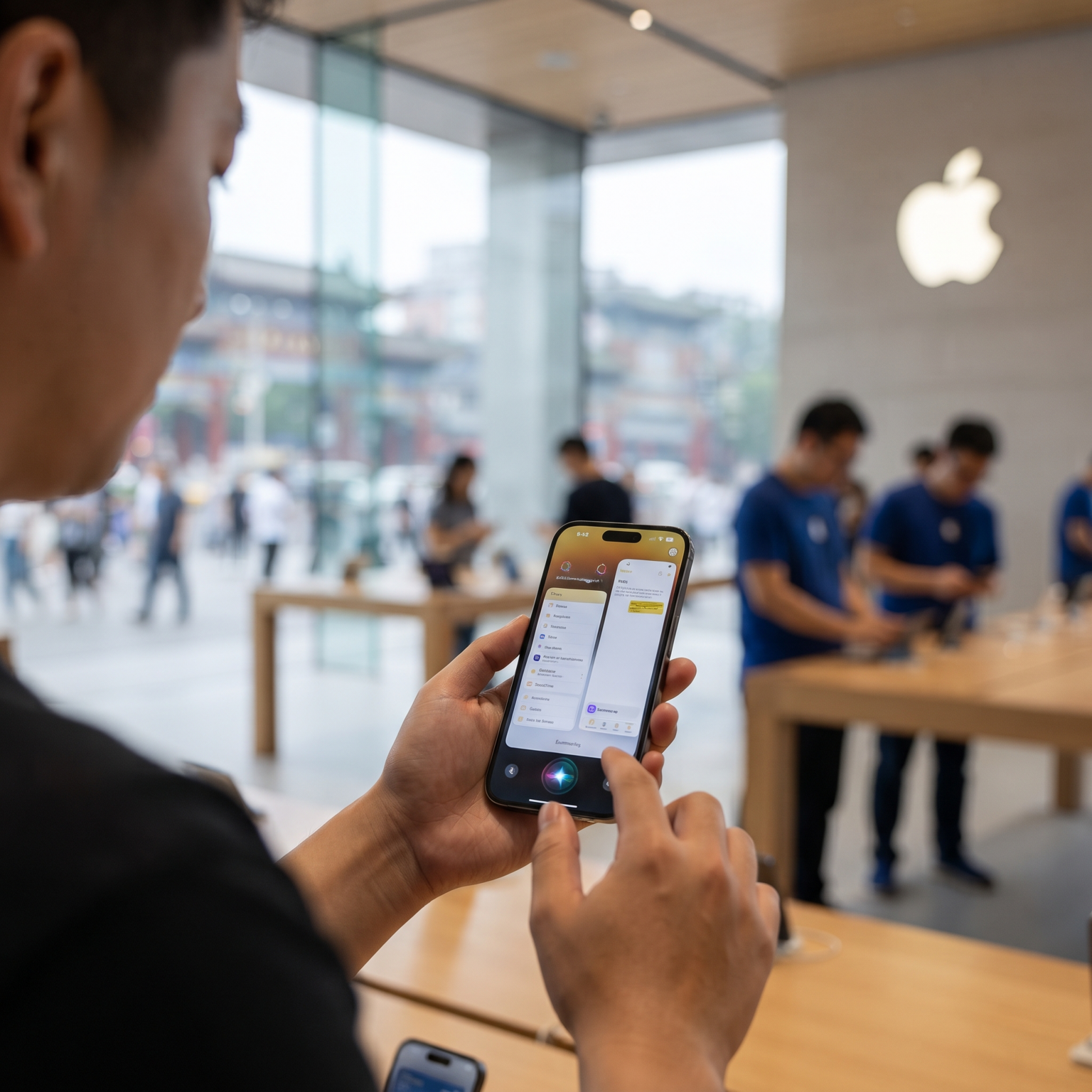
Apple says Apple Intelligence will reach mainland China in December through iOS 27.3, marking a consequential expansion of its generative AI strategy into the world’s largest smartphone market. Apple has scheduled a beta for November 4, giving developers and early adopters a first look before the public release, while leaving little time to resolve localization and reliability issues. The rollout is notable not simply because Chinese iPhone owners will gain new tools, but because Apple has spent years navigating the regulatory and commercial constraints that shape AI services in China. The company says the initial package will not include every Apple Intelligence capability, making this a carefully staged arrival rather than a complete version of the platform.
The delay has made the launch more than a routine software update. Apple introduced Apple Intelligence in other markets earlier, but bringing generative AI to China requires a different mix of technology, partnerships and regulatory approvals. China requires providers of generative AI services to meet local rules, and foreign companies have generally relied on domestic partners to make products available there. Apple CEO Tim Cook said in July that the company had received approval to ship what he called the original Apple Intelligence features, indicating that the first release would be narrower than the full international offering. That distinction matters: availability is a milestone, not evidence that every promised feature is ready for Chinese users.
Reports say Alibaba’s Qwen model will help power some of the China-specific experience, including capabilities connected to Siri. The arrangement reflects a practical compromise: Apple can bring AI functions to customers while working with a locally established technology provider, rather than simply transferring its entire overseas service unchanged. Qwen is a family of large language models developed by Alibaba, designed to interpret prompts and generate responses, much as other conversational AI systems do. The partnership also places a prominent Chinese technology company inside a core iPhone experience, illustrating how global software increasingly depends on regional infrastructure and collaborators. Apple has not detailed every feature or technical division of labor, so the precise scope should become clearer as testing proceeds.
For users, the most tangible changes are likely to be everyday conveniences: asking Siri for help, rewriting or summarizing text, and using AI to make information easier to understand or act upon. Features that can interpret personal context or work across apps are particularly useful when they reduce small frictions, such as drafting a message or finding a detail buried in a long conversation. Yet the China release should not be assumed to mirror functions available elsewhere, and some capabilities may be absent, delayed or adapted to local services. That unevenness could confuse customers who compare demonstrations, support pages or imported devices, especially if the same Apple Intelligence label describes different feature sets. Clear explanations inside Settings and at the point of purchase will therefore matter as much as the model’s fluency.
Apple’s challenge is to make the system feel unmistakably integrated into the iPhone while satisfying expectations around privacy, safety and local compliance. The company has emphasized that Apple Intelligence combines on-device processing with private cloud computing for tasks that need more power; in the latter case, requests are designed to be handled without retaining personal data. How those protections operate in the China-specific setup will be a critical question for privacy-conscious buyers, particularly when a local partner’s model is involved. Apple must also make responses dependable across Chinese languages, regional phrasing and cultural context, where a technically impressive model can still stumble in practical use. For businesses, the same issues determine whether AI assistance is safe and predictable enough for workplace documents, customer service or internal workflows.
The commercial stakes are substantial. Apple remains a major premium-phone seller in China, but faces intense competition from domestic brands that are rapidly adding AI features to devices and software. A credible local launch could help Apple defend the iPhone’s appeal, encourage upgrades and reassure developers that the platform is not being left behind in a defining technology shift. It will not, by itself, solve broader pressures on sales, pricing or competition, and rivals may already offer broader AI functions or tighter links to popular local services. Still, even a limited release gives Apple a route to learn from local users and build toward a more capable offering, while Alibaba gains visibility for Qwen through a globally influential consumer product.
The November beta will offer the first practical test of Apple’s approach, but a developer preview is not a guarantee that every feature will ship unchanged in December. Testers can expose problems with language quality, latency, integrations and edge cases before the update reaches a much larger audience; customers should expect details to evolve. Apple’s longer-term opportunity lies in making AI useful without turning the iPhone into a collection of disconnected chatbots: assistance should appear where people already write, search and communicate. Its longer-term risk is that regulatory limits or uneven functionality make the experience feel like a second-tier version of a product marketed elsewhere as a major platform shift. For the industry, China’s launch is a reminder that the AI race is not only about building powerful models; it is also about partnerships, governance and delivering dependable tools within the rules of each market.