








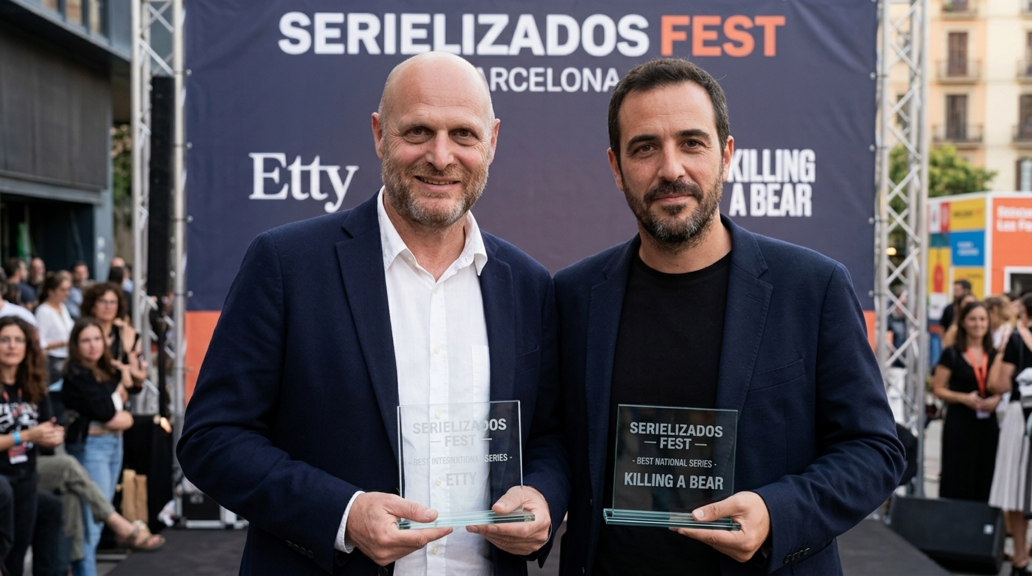
At Barcelona’s Serielizados festival, two very different series shared the spotlight: Hagai Levi’s Etty won best international series, while Spanish creators Jorge and Alberto Sánchez-Cabezudo took best national series for Killing a Bear. The awards place a historical drama rooted in personal testimony beside a homegrown title whose arrival has already drawn attention on the festival circuit. Serielizados also awarded its Mind the Gap pitch prize to El Observatorio, recognizing a project at an earlier stage of development. Together, the results offer a snapshot of television’s expanding ambitions, where established auteurs, national storytelling and new ideas can compete for attention in the same room. For viewers, they are also an invitation to look beyond familiar platforms and discover work shaped by distinct voices and perspectives.
Etty draws on the diaries of Dutch Jewish writer Etty Hillesum, whose records of life under Nazi persecution have made her an enduring figure for readers. Levi, known internationally for The Affair and Scenes From a Marriage, has chosen a modern approach to this French-Dutch-German production rather than treating its historical setting as a distant museum piece. That decision matters: a series about a real person’s words must find a way to make those words immediate without obscuring the circumstances in which they were written. The international award signals that Serielizados’ jury saw force in Levi’s interpretation, while giving the title a valuable platform among viewers who may not yet know Hillesum’s work. It also extends Levi’s reputation for intimate, morally complicated storytelling.
For Levi’s audience, Etty represents both continuity and a change of scale. His earlier best-known projects have examined relationships and private choices, often letting emotional uncertainty drive the drama; Hillesum’s diaries connect inward reflection to a catastrophe affecting millions. Bringing that material to television creates a challenge as well as an opportunity: audiences may encounter history through an individual consciousness, but the story must not reduce history to one person’s experience. A modern spin can help bridge that distance, especially for younger viewers who meet the past through contemporary screen language. The honor does not settle how every viewer will respond, but it increases visibility for a project that asks audiences to listen closely to a voice preserved across time.
Killing a Bear’s win gives the national prize to Jorge and Alberto Sánchez-Cabezudo, brothers whose recognition underscores the strength of Spain’s television storytelling. The available festival announcement identifies the series as the national category’s winner, but offers limited detail about its plot; the significance here is therefore the achievement and the attention it brings, rather than assumptions about its themes. A festival award can help a series stand out in a crowded marketplace, where local productions compete not only with one another but with global releases promoted by powerful distributors. For Spanish viewers, the result is a reason to watch for a new work from familiar creative talent. For international buyers and critics, it is a signal to take notice of a series grounded in Spain’s own production culture.
The pairing is revealing because international and national categories answer different questions. Etty arrives as a multilingual European collaboration, while Killing a Bear represents work judged within Spain’s national field; both nevertheless share a stage built around serialized storytelling. Television now travels across borders more readily, but a show’s identity still matters: language, history and local creative traditions can distinguish it in a world of abundant content. Festivals give those differences a public setting, helping critics and industry professionals encounter titles that might otherwise be overshadowed by larger marketing campaigns. Awards do not guarantee broad distribution or a devoted audience, yet they can create the first spark of curiosity. For fans, that discovery function is part of the appeal: one prize list can lead to stories well outside their usual viewing habits.
El Observatorio’s Mind the Gap pitch prize highlights another part of the business, often less visible to viewers: the development stage, when a project is presented in hopes of attracting support and moving toward production. A pitch award is not the same as a completed series or a guarantee that one will be made. It does, however, give an idea recognition and may help its creators build relationships with partners who can offer financing, expertise or distribution. That distinction makes the prize meaningful without overstating what it promises. In an industry where many concepts never reach the screen, a festival platform can help emerging work find a path forward. Viewers may not see that process, but it shapes which stories eventually become available to them.
Taken together, the three honors show how festivals serve more than a celebratory purpose. They can connect a celebrated creator such as Levi with new audiences, elevate Spanish production, and draw attention to a project still seeking its next step. The choices also reflect a medium increasingly comfortable moving between intimate biography, nationally rooted series and early-stage experimentation. For audiences, that mix broadens the map of television: historical material can feel newly immediate, domestic productions can earn recognition beyond their borders, and a pitch prize can mark a story worth following before it has a release date. Serielizados has not made these works equally accessible everywhere, and awards alone cannot predict their eventual reach. But its results give fans a useful guide to what deserves a closer look.
The human thread connecting the winners is the act of making a voice heard: Hillesum’s preserved diary, the Sánchez-Cabezudo brothers’ series, and the still-developing idea behind El Observatorio each depend on audiences being willing to engage. That is especially resonant in a period when viewers face more choices than ever and attention is a scarce resource. Recognition from a festival can help cut through the noise, but lasting impact will depend on the finished work, its availability and the conversations it inspires. For now, Etty’s international victory and Killing a Bear’s national honor place both titles on the radar, while El Observatorio earns a foothold in the industry’s next-generation pipeline. Serielizados’ winners suggest that television’s future belongs not to one format or territory, but to stories that give audiences a compelling reason to look closer.