







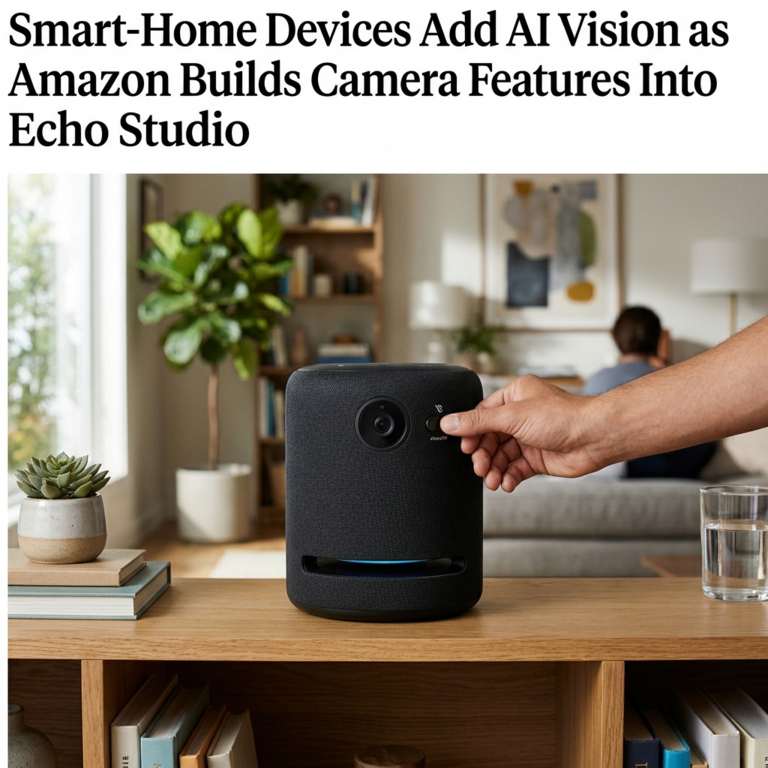
Amazon is bringing a camera into the center of its smart-home experience, turning the Echo Studio from a voice-first speaker into a device that can also interpret scenes inside a home. The new Echo Studio with Home Camera pairs that visual feed with Alexa+, Amazon’s upgraded assistant, so users can ask questions about what the camera sees rather than simply check a live video stream. A physical kill switch gives owners a direct way to disable the camera, acknowledging that adding vision to a room raises questions ordinary speakers do not. The product is a sign that smart-home hardware is moving from responding to commands toward interpreting context.
That shift could make routine monitoring more useful. A conventional camera captures footage, and a person must look at it or review alerts to learn what happened; an AI-enabled assistant could, in principle, answer questions in everyday language about visible activity. The distinction matters to people who want to know whether a delivery arrived, whether a pet is in a room, or whether something appears out of place without opening an app and scanning video. Amazon’s announcement centers on Alexa+ interpreting camera input, but the practical value will depend on how reliably the system identifies scenes and how clearly it communicates uncertainty.
The approach builds on Amazon’s existing smart-home ecosystem, where Alexa can control connected devices and compatible Echo products can display camera footage. Developers have long been able to connect products such as lights and cameras to Alexa, while Amazon has promoted voice control as a way to make home automation more accessible. Adding visual understanding potentially links those separate functions: a user might ask about an event and then take action through the assistant. That could make a smart home feel less like a collection of apps and more like a coordinated service, provided devices work consistently across brands and connections.
For consumers, convenience is only half the proposition. A camera inside a home can capture family routines, visitors, and private spaces, while an assistant that analyzes images introduces questions about where processing occurs, what is retained, and who can access the resulting information. The physical kill switch is meaningful because it offers a visible, tangible control, rather than asking users to trust a setting buried in software. Still, disabling a camera does not by itself explain data handling when it is active; buyers will need clear answers about storage, access, retention, and whether analysis happens locally or in the cloud.
Amazon is entering a crowded market in which smart speakers, security cameras, and home assistants increasingly overlap. The combination could distinguish Echo hardware from speakers that mainly play audio or answer spoken questions, especially if Alexa+ can turn visual information into useful, timely assistance. It also raises the stakes in a competitive race: companies are seeking to make AI feel present in daily life, not merely available in a separate chatbot. For Amazon, the home is a natural arena, since Alexa already connects users to shopping, entertainment, and compatible devices, but trust will shape whether that reach becomes an advantage or a liability.
There are potential accessibility benefits as well. For people with vision impairments, spoken descriptions of activity or objects could make a room’s changing conditions easier to understand, complementing existing accessibility tools and voice interfaces. For busy households, conversational questions may be simpler than navigating camera menus, and businesses could eventually apply similar ideas to monitoring spaces or supporting staff. Those possibilities should be treated as potential uses, not guarantees: camera interpretation can miss details, misunderstand ambiguous scenes, or produce confident-sounding errors, so users should not rely on it for emergencies or decisions where accuracy is critical.
The larger test is whether Amazon can make visual AI useful without making home life feel watched. A camera-equipped speaker must earn a place in a private room through dependable performance, understandable controls, and transparent privacy practices, not just a novelty demonstration. Consumers should look for precise explanations of what Alexa+ can recognize, how the kill switch behaves, and which features require connectivity or subscriptions, as applicable. If the experience proves trustworthy, the Echo Studio could help normalize homes that respond to what is happening, not only to what residents say; if it does not, the same camera may become a reminder that convenience has a cost.