









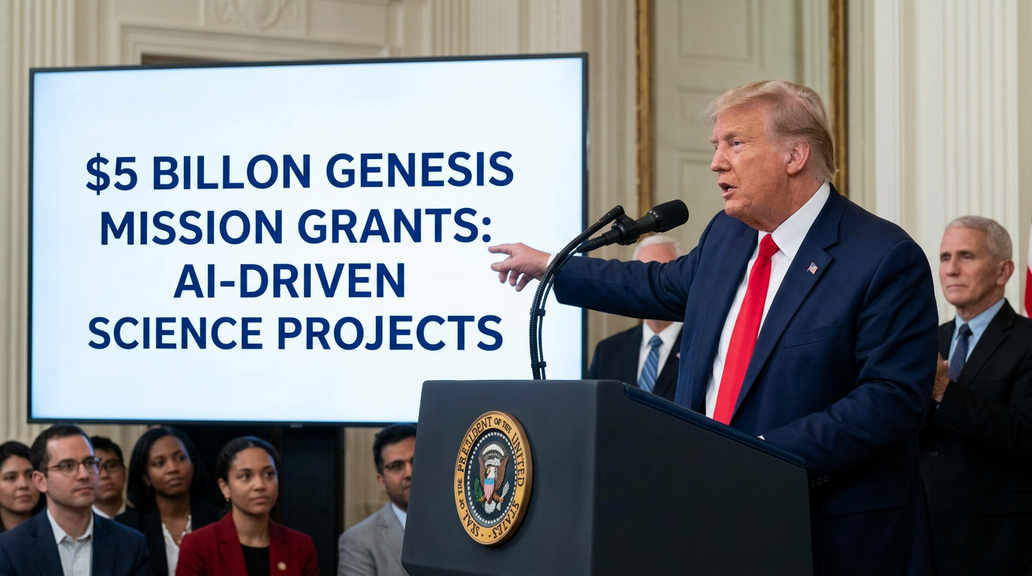
The Trump administration has made a bold move in the realm of technology and science with the unveiling of the $5 billion Genesis Mission grants for AI-driven science projects. This initiative, likened to the urgency and ambition of the Manhattan Project, aims to propel the country forward in the field of artificial intelligence and scientific discovery. Science adviser Michael Kratsios is actively advocating for the Genesis Mission grants on Capitol Hill, highlighting the administration’s commitment to leveraging AI for the betterment of society and advancement of scientific research.
The allocation of such a substantial amount of funding towards AI-driven science projects signifies a significant shift in the prioritization of technology in the U.S. government’s agenda. With the Genesis Mission grants, the administration is signaling a strong endorsement of AI as a key driver of innovation and progress across various scientific disciplines. By investing in cutting-edge AI technologies, the government is positioning the country at the forefront of scientific research and technological development, potentially paving the way for groundbreaking discoveries and advancements in the near future.
The Genesis Mission grants are expected to have a far-reaching impact on the tech industry as well as on academia and research institutions. The infusion of $5 billion into AI-driven science projects will likely spur collaboration between government agencies, academic researchers, and industry leaders, fostering a robust ecosystem of innovation and knowledge sharing. This collaboration is crucial for accelerating the pace of scientific discovery and pushing the boundaries of what is currently possible in fields such as healthcare, climate science, and space exploration.
One of the key goals of the Genesis Mission grants is to harness the power of AI to tackle some of the most complex scientific challenges facing society today. By leveraging AI algorithms and machine learning techniques, researchers will be able to analyze vast amounts of data, identify patterns and trends, and make predictions with a level of accuracy and speed that was previously unattainable. This has the potential to revolutionize how scientific research is conducted, leading to breakthroughs in areas such as drug discovery, renewable energy, and environmental conservation.
The Trump administration’s focus on AI-driven science projects through the Genesis Mission grants underscores the growing importance of artificial intelligence in shaping the future of technology and innovation. As AI continues to permeate various sectors of society, from healthcare to finance to transportation, the need for robust AI research and development becomes increasingly apparent. The Genesis Mission grants provide a crucial boost to the AI ecosystem in the U.S., enabling researchers and innovators to push the boundaries of what is possible and drive progress in scientific discovery.
In conclusion, the announcement of the $5 billion Genesis Mission grants for AI-driven science projects marks a significant milestone in the intersection of technology, science, and government policy. This initiative signals a strong commitment to leveraging AI for the betterment of society and the advancement of scientific research, positioning the U.S. at the forefront of innovation and discovery. As the Genesis Mission unfolds, it is poised to catalyze a new era of collaboration, innovation, and progress in the field of artificial intelligence and scientific discovery.